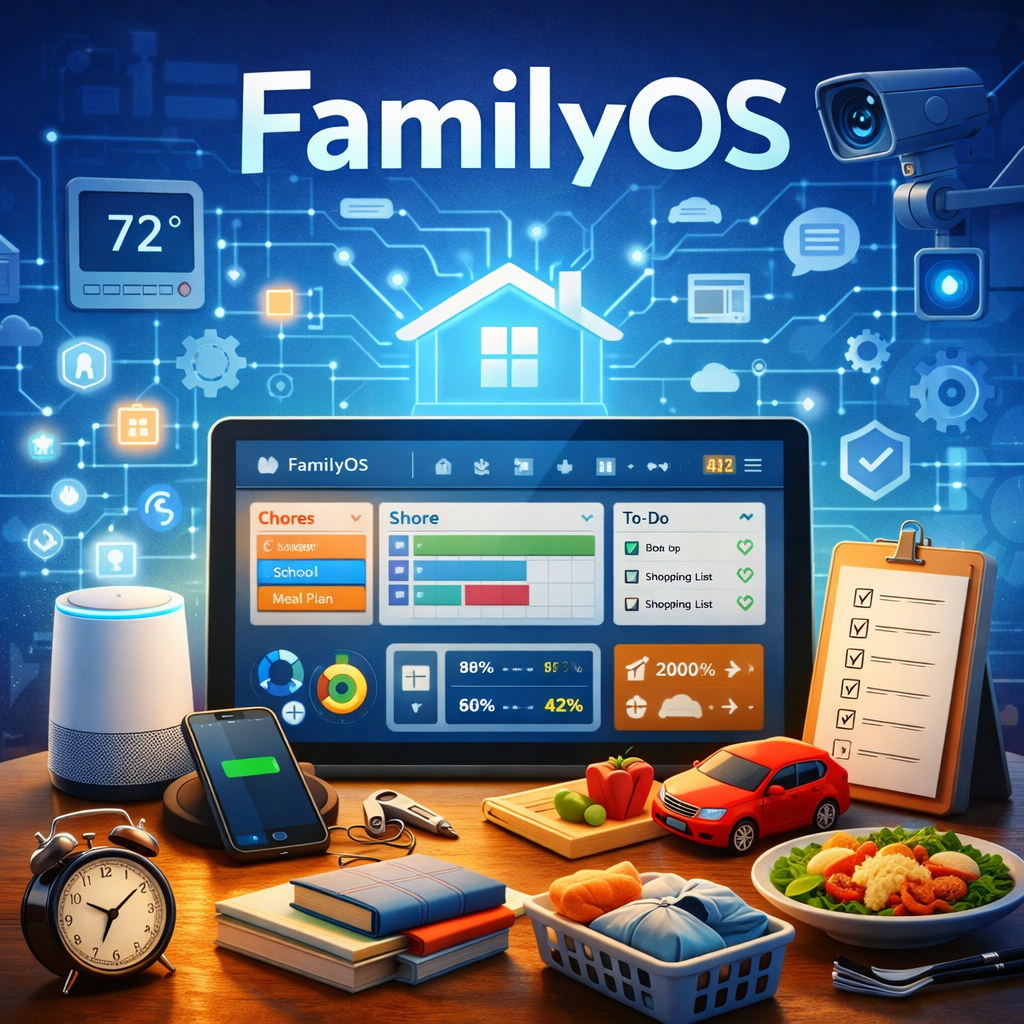
It started in one of those moments where you are scrolling without really looking for anything, until something small catches your attention and lingers longer than expected. The idea was simple: “FamilyOS” as an emerging space for tech innovation. Investors are starting to pay attention, looking at tools and systems designed to help families coordinate better and reduce friction. At first it sounded like just another buzzword, another attempt to turn everyday life into software. But over time, it made more sense. Because when something like this shows up on investors’ radar, it usually points to something real.
🔌 The charger that explained everything
A few days later, it showed up in real life. A phone charger was not where it was supposed to be and suddenly everyone needed it at the same time. No one moved it (apparently), no one knew where it went and yet it became a problem.
You know how this goes:
Who took my charger?
I thought it was in the living room?
Why is this always a thing?
It was never really about the charger. It was about the fact that no one had defined how things work.
😅 Why this feels different right now
This kind of friction is not new, but it feels heavier lately. Across Europe, there are over 202 million households, of which more than 75 million are single person households, growing rapidly in recent years.
Source: Eurostat Europe
At the same time, more than half of households have all adults working, which means less time, more coordination and more pressure on how daily life is organised.
Source: Eurostat Europe
Add to that the broader backdrop, economic pressure, global tensions and constant news cycles…and it is no surprise that even small things start to feel amplified.
That is when the idea behind FamilyOS starts to land, not as a product, but as a way of looking at things. Every setup already runs on a system: someone notices problems, someone takes action and someone assumes it is not theirs. Most of this happens silently, without agreement or clarity.
🧠 FamilyOS is not software. It is awareness
Yes, tech companies might build tools around this idea, but the real shift is much simpler: make how things work visible. Because once something is visible it can be improved, and once it is improved, small daily frictions start to disappear. Especially in a world that feels increasingly unpredictable, that clarity becomes more valuable than ever.
🚀 Small upgrades that make a big difference
Start with something simple, like the charger. Instead of letting it be a recurring issue, create a shared rule: if you move it, you return it. Then think about low energy days and define a default instead of deciding every time.
What do we do when we are tired?
What gets skipped and what is good enough?
Not every day needs to be optimal, some days are just about keeping things running.
🔕 Build in space, not just structure
In a world that constantly demands attention, sometimes the most valuable thing is a pause. A short moment with no logistics, no planning and no decisions, just quiet. It does not sound like much, but it can reset the tone of everything around it. Structure helps things run, but space helps people breathe.
You do not need to redesign everything overnight and trying to usually makes things worse. Instead, improve one thing at a time: one unclear task, one repeated annoyance and one assumption turned into an agreement. Small changes feel insignificant in the moment, but over time they compound into something much bigger.
🏠 It works, no matter your setup
Whether you live alone, with others or somewhere in between, the principle stays the same. Less guessing, more clarity. If you are on your own, it reduces mental load and decision fatigue, if you share responsibilities, it removes ambiguity and silent expectations. Different lives, same idea: clarity reduces friction.
💡 Why this matters now
Because this is not just about organisation, it is about stability. In Europe, around 8% of children live in jobless households, showing how quickly situations can change.
Source: Eurostat Europe
Life changes sometimes gradually, sometimes all at once, but most setups do not update how they operate when it does.
✨ The real shift
Back to the charger. A week later, it would not have gone missing, not because people became more responsible, but because the system became clearer. There was a place for it, a simple rule around it and shared expectations. No tension. No confusion.
FamilyOS is not about turning life into software, it is about recognising something simple: most friction comes from things that were never clearly defined. Start small, notice one pattern, name it and improve it. And watch how quickly things begin to feel lighter. ✨